
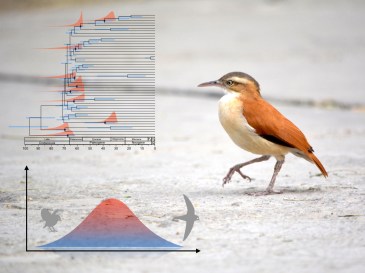
We are interested in how birds evolved and diversified, specifically, in how speciation, extinction, dispersal and phenotypic evolution interacted over time and space during the diversification process to produce the diversity of birds we observe today. We develop new tools for improving the estimation of time-scaled phylogenies and for the quantification of fundamental processes such as dispersal. Our work aims aims at the integration of evolution and ecology. The following are the main topics of our research:
Time-scaled phylogenetic trees of birds
 Accurate time-scaled phylogenetic trees are fundamental for studying the process of evolutionary diversification. We are exploring new strategies for the estimation of time-scaled phylogenies for the study diversification dynamics. One of our proposed new strategies for calibrating molecular clocks from the fossil record (Claramunt 2022) is now implemented in our R package CladeDate. This method was used for the first time in our study of modern birds (Claramunt & Cracraft 2015), and more recently in the calibration of a > 1.2 thousand species phylogeny of suboscine passerines (Harvey, Bravo, et al. 2020) and a family-level genomic tree of birds (Stiller et al. 2024), the later part of our collaboration with the Bird 10,000 Genomes Project (B10K, Feng et al. 2020).
We are also interested in generating comprehensive large-scale phylogenies of birds. We recently assembled a tree of 9,000 species by combining published trees and genetic data from GenBank (Claramunt et al. 2025).
Climate change and diversification in birds
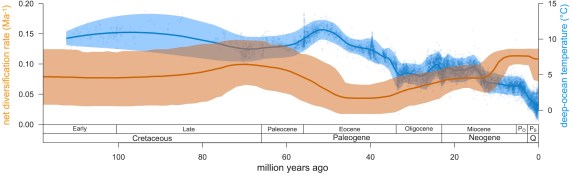
Our analysis of the the new time-tree of modern birds revealed a striking pattern in which net diversification rates were negatively correlated with global temperatures: periods of slow diversification coincide with long-term trends of global warming while it is in periods of planetary cooling that diversification is faster. We interpreted this as the effect of tropical biome retraction and fragmentation (Claramunt & Cracraft 2015). We are now investigating this pattern and its explanation with more comprehensive and accurate time-trees.
Dispersal ability in macroecology and macroevolution
Dispersal is a fundamental process in ecology and evolution; yet, it has resisted investigation at macroecological and macroevolutionary scales because it is difficult to quantify. We are investigating ways of estimating the dispersal capabilities of birds based on their flight morphology and then use that information to investigate how dispersal influences the diversification process at macroevolutionary scales. Contrasting views are held regarding the role of dispersal on bird diversification but empirical testing has been challenging because of difficulties in quantifying dispersal. We are pioneering the use of wing morphology and avian aerodynamic theory to quantify the dispersal ability of birds and investigate the process of dispersal in ecology and evolution (Claramunt et al. 2012, Weeks & Claramunt 2014, Claramunt et al. 2025).

We are validating dispersal proxies using field data on bird movement such as gap-crossing observations and dispersal-challenge experiments in Amazonian birds (Claramunt et al. 2022, Naka et al. 2022) as well as data on natal dispersal distances (Claramunt 2021, Weeks et al. 2022, Chu & Claramunt 2023). Because proxies that require information on wing area, such as the aspect ratio and the lift-to-drag ratio, are better than the hand-wing index, we have been developing new methods for estimating wing areas from museum specimens (Fu et al. 2023). Moreover, our results are revealing important aspects of the dispersal process in birds, like its dependency on flight efficiency and its negative correlation with population size (Claramunt 2021, Chu & Claramunt 2023). Our global analysis across birds revealed the complex interplay between dispersal ability, geographic range size and diversification rates (Claramunt et al. 2025).
We have been also exploring the genomics of flight and dispersal in birds, initially focusing on the mitochondrial genome (Claramunt & Haddrath 2023). Our research on dispersal has important implications for conservations, as it suggests that species with low flying capabilities may be more vulnerable to habitat fragmentation and climate change.
Diversification of the Neotropical ovenbirds and woodcreepers
The Furnariidae (Neotropical ovenbirds and woodcreepers) is one of the most spectacular avian radiations, not only very diverse in number of species (nearly 300, the fourth largest avian family in the Americas) but also highly diverse in ecomorphological adaptations and specializations. Like Darwin’s finches in the Galapagos islands, they diversified both in number of lineages and in morphological and ecological traits but they have done so to a much greater degree and across an entire continent. We have been investigating the Furnariidae integrating species-complete phylogenetic trees and a variety of phenotypic, ecological, and climatic datasets with the ultimate goal of understanding the processes of diversification in continents.
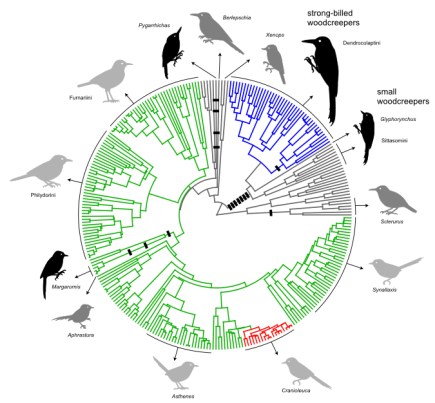
In previous work, we discovered that the Furnariidae does not follow the classic patterns of adaptive radiations shown by island radiations such as Darwin’s finches: diversification through time in Furnariidae is not slowing down towards the present, suggesting that they are not being limited by competition (Derryberry et al. 2011), key innovations are not very influential on diversification rates (Claramunt et al. 2012), and character displacement is not detectable (Tobias et al. 2014). Therefore, it is possible that other factors such dispersal ability (Claramunt et al. 2012), geography (Claramunt 2014) and climate (Seeholzer et al. 2017) are more important for this large and old continental radiation. New phylogenomic analyses and improved time-calibrations will increase our ability to detect patterns and evaluate process related to the diversification of the Furnariidae.
Avian collections and systematics
We are also very interested in contributing to the development of research collections and avian systematics and classification. Santiago has described six genera (Geocerthia, Certhiasomus, Pseudasthenes, Drymotoxeres, Mazaria, Neophylidor), one subgenus (Cryptomolus), and one fossil species (Pseudoseisuropsis cuelloi).
Santiago’s work in the South American Classification Committee contributes to the creation of a standard authoritative classification of birds of the most diverse continent on our planet. He has also contributed significantly to the knowledge of the birds of Uruguay, Santiago’s homeland, as he is involved in studies of diversity, distribution, and conservation of Uruguayan birds, he is the Uruguay country list coordinator of the South American Classification Committee and author and illustrator of the guide of the birds of Montevideo city (see online edition).
 Avian Evolution in Space and Time